What improvement actually is

The four levels, in full

Eight threads of craft, four levels deep, and a 14-criterion marking sheet with a written descriptor for every band. Published whole, on one page, because "they are improving" is a feeling and this is an instrument.

Read it in fifteen seconds

Where a student starts, and what they are working towards

Four levels, each one written down before any student arrived. A student does not sit an exam to move between them; a teacher who has filmed them every week can tell you which descriptors they are meeting and which they are not.

01

Basic

Students meet the fundamentals: primary techniques, basic character creation and simple scene development, with introductory improvisation, first voice modulation, and the beginnings of narrative structure.

8 of 8 threads
02

Intermediate

The focus moves to more complex characters, a wider emotional range and deeper script analysis. Voice work extends to distinct character voices, and basic Meisner and Method tools are introduced.

8 of 8 threads
03

Advanced

Complex technique, including emotional layering and advanced improvisation. Students build sophisticated narratives and multi-dimensional characters, and voice work extends to accents and complex emotional expression.

7 of 8 threads
04

Professional

High proficiency across nuanced performance, professional emotional depth and compelling presence, using either Meisner or Method deliberately. This level prepares a student for professional roles.

6 of 8 threads

Two threads stop short, and we have left them short. The curriculum carries no descriptor for scene and narrative construction above intermediate, or for presence and audience at professional. That is a gap in the document rather than a gap in the teaching, and writing something plausible into the empty cells would make this page worth less, not more.

Every thread, every level

Follow one thread all the way up

The whole progression, 8 threads across 4 levels. Read a row to see how one part of the craft develops, or a column to see what a student at that level can do.

01Improvisation and characterBasic improvisation exercises creating simple characters, fostering creativity and spontaneity.Exploring more complex characters, delving into motivations and backgrounds.Complex improvisation scenarios, building multi-dimensional characters with depth and realism.Mastering improvisation, creating deeply nuanced and believable characters suitable for professional performance.
02VoiceBasic voice exercises, learning to modulate tone and pitch.Developing distinct character voices, exploring a range of vocal expressions and dynamics.Mastering complex voice acting including diverse accents and emotional expressions.Refining voice technique, adapting for various characters and media with versatility and authenticity.
03Emotional rangePortraying basic emotions and understanding primary emotional states.Exploring a wider range of emotions, developing emotional authenticity and deeper character connection.Portraying complex emotional states, mastering emotional layering and depth.Creating emotionally compelling and nuanced performances across a wide spectrum.
04Presence and audienceBasic confidence, connecting with the audience and understanding audience engagement.Developing stronger stage presence, reading and responding to audience reactions.Using sophisticated technique to captivate an audience and create a dynamic presence.The curriculum carries no descriptor for this thread at this level.
05Scene and narrative constructionConstructing simple scenes and learning the basics of narrative structure.Developing more intricate scenes, exploring subplots and character relationships.The curriculum carries no descriptor for this thread at this level.The curriculum carries no descriptor for this thread at this level.
06VersatilityAdapting to different roles and styles at a basic level.Demonstrating versatility across a range of genres and styles.Mastering adaptability, transitioning seamlessly between diverse roles and contexts.Excelling across a wide spectrum of acting challenges, suitable for a professional career.
07Analysis of performanceIdentifying basic elements like tone and expression.Detailed analysis of character development, emotional expression and motivation.Evaluating subtleties such as subtext and emotional layering.Critically analysing performance for nuanced technique, discerning artistic choices and styles.
08Reflective practiceEngaging in reflective practice and feedback integration.Reflecting on varied acting styles and feedback, adapting approach.In-depth self-critique emphasising emotional authenticity and character consistency.Comprehensive critique, incorporating complex feedback and adapting performance for various media.

The marking sheet

How a performance is actually marked

14 criteria, three descriptors each, taken from FilmLab's own audition criteria document rather than written for this page. This is the instrument a teacher uses, in full.

01ConfidenceStruggles with nervousness, needs to work on self-assurance.Generally confident with occasional uncertainty.Highly confident and composed, regardless of the situation.
02PresenceDeveloping the ability to engage the audience.Commands attention with growing consistency.Captivates and holds the audience's attention effortlessly.
03CharacterizationShows initial understanding of character but lacks depth.Demonstrates a good grasp of character with emerging depth.Deep and nuanced understanding of character, making it fully believable.
04Emotional RangeLimited emotional expression; working on expanding emotional responses.Shows a broad range of emotions, though not always deeply.Wide and convincing range of emotions, portrayed with profound depth.
05DeliveryWorking on clarity, enunciation, and projection; inconsistent.Clear delivery with good projection; occasional lapses in enunciation.Exceptional clarity, enunciation, and projection in all spoken dialogue.
06ConnectionDeveloping connection with scene partners and audience; inconsistent.Strong connection with scene partners and audience most of the time.Consistently establishes a deep connection with scene partners and audience.
07AdaptabilityLimited in making adjustments based on direction; needs guidance.Adapts to direction with some ease, showing flexibility.Highly adaptable, making creative adjustments on the spot with ease.
08CommitmentShows initial commitment to character and scene; can be hesitant.Generally committed to character and scene with occasional lapses.Fully committed and dedicated to character and scene, regardless of challenges.
09Camera AwarenessLearning camera angles and framing; needs improvement on awareness.Understands basic camera work; improving on using it to enhance performance.Masterful use of camera angles, framing, and blocking to enhance performance.
10Facial ExpressionsDeveloping expressive use of face to convey emotions; can be stiff or exaggerated.Uses facial expressions effectively most of the time; room for nuanced improvement.Expertly uses facial expressions to convey a wide range of emotions subtly.
11Body LanguageWorking on awareness and control of body movements; can be unnatural.Good control of body language, effectively conveying character's emotions.Excellent awareness and control of body language, enhancing character portrayal.
12Eye ContactDeveloping appropriate use of eye contact; can be inconsistent.Mostly maintains appropriate eye contact, enhancing connection.Consistently uses eye contact effectively, adding depth to performance.
13Screen PresenceBeginning to develop screen presence; can be overshadowed.Has a noticeable screen presence, commanding attention.Dominates the screen with a compelling presence, engaging the audience fully.
14Energy LevelEnergy can fluctuate, affecting performance consistency.Maintains a good energy level throughout performances.Exhibits high and consistent energy levels, invigorating performances.

Alongside the 14 there is a progress row, tracked rather than scored, across skills development, character range, script analysis, feedback incorporation, consistency, collaboration, versatility and self-reflection. At beginner it reads "shows initial understanding and application; significant room for growth". At advanced it reads "exhibits mastery and sophisticated application of all assessed skills".

The scale a total score falls onOut of 100

Advanced

Mastery in all areas. Continues to challenge with complex roles.

90-100

Intermediate-Advanced

Proficiency and emerging mastery. Focus on nuanced performance and complex character development.

70-89

Intermediate

Solid foundational skills, with room to grow in emotional expression and character understanding.

50-69

Beginner-Intermediate

Developing confidence and skill set. Engage more deeply in character analysis and emotional range.

30-49

Beginner

Early stage. Focus on foundational technique, confidence building and basic scene analysis.

0-29

None of this exists to make anyone feel measured, and no student is ever handed a score out of a hundred. It exists because anyone paying by the term, an adult student or a parent, is entitled to know what the thing being taught actually consists of, and "they seem more confident" is not an answer to that.

Where each student sits

Ask, and you get a descriptor rather than a compliment

Every performance is filmed, so a teacher answering that question is not working from memory. They can point at the row, say which descriptor the student is meeting, and show you the take it came from.

None of this is an accreditation and we do not present it as one. It is the studio's own instrument, written by the person who wrote the curriculum, and it is on this page so you can judge it before you enrol rather than after.
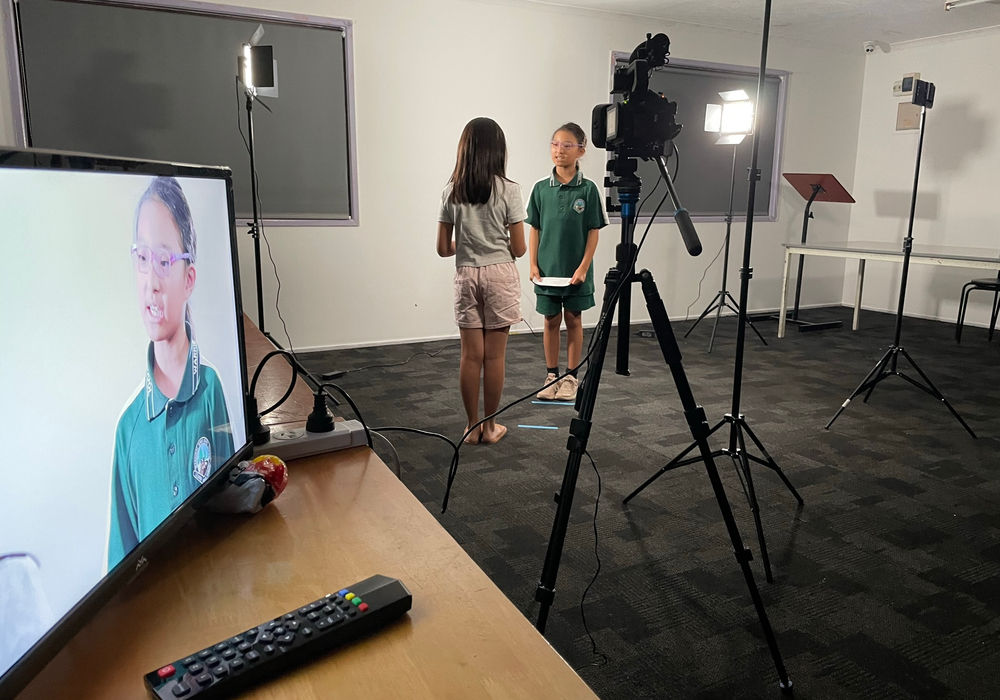
Two students to camera in a classroom with a monitor beside them showing the playback
THE TAKE, AND THE NOTEMarked against a written descriptor, with the footage to point at.